Roof turrets
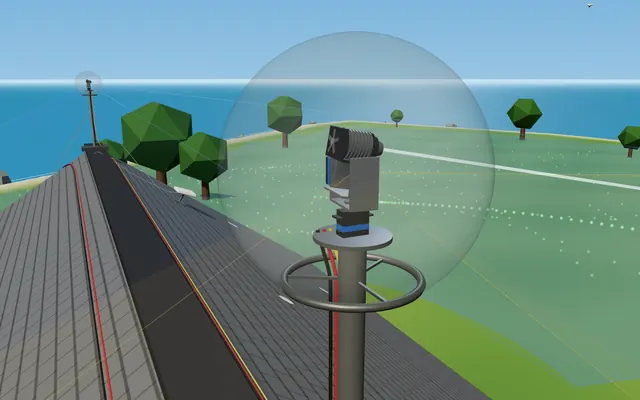
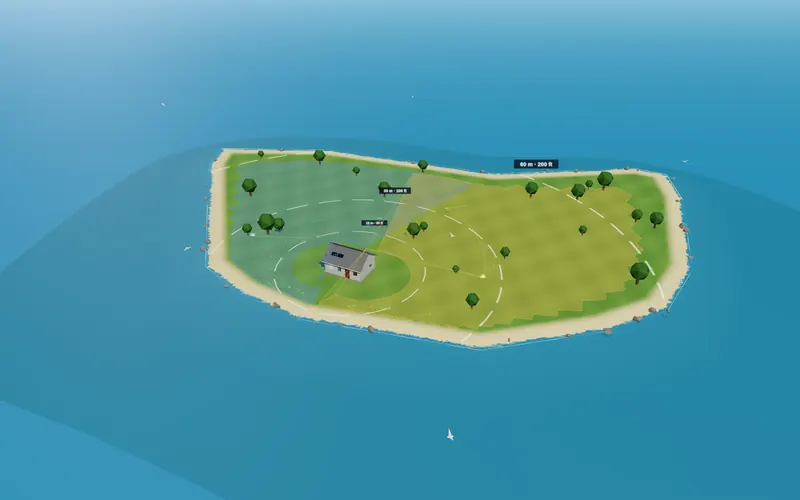
Two turrets on the ends of the roof ridge, each a pan-tilt head under a clear dome. Between them they cover a full ring of ground around the house.

Laser bird control that sends gulls packing.
A solar-powered laser gull deterrent, built safety-first and run from a remote phone dashboard.
Experimental prototype · first field test on Poop Island, 2026–2027
Once a flock of ring-billed and herring gulls decides a place is theirs, it stops being yours. Spikes, owls and flags only go so far, and the birds learn fast.
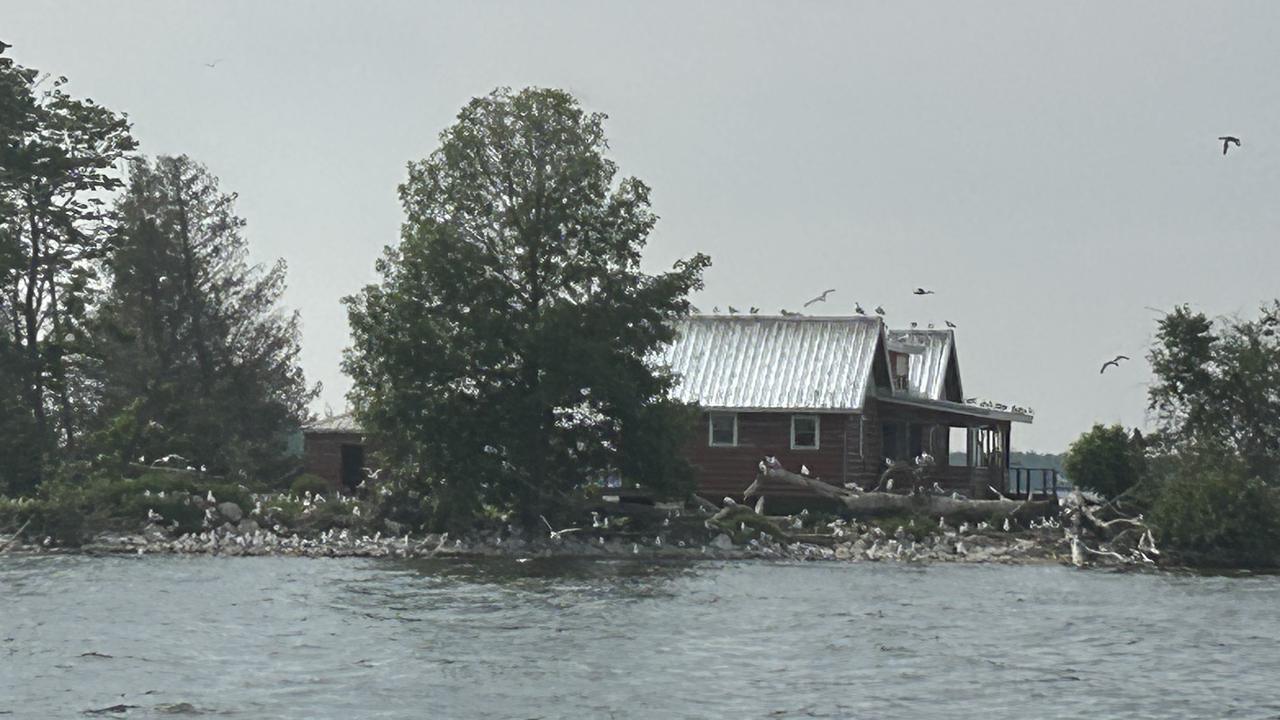
Hundreds of ring-billed and herring gulls on the roof ridges, packed along the rocky shoreline and wheeling overhead. Todd Pierantoni bought the island and hasn't been able to enjoy it since.
We couldn't even get close to the dock. Between the smell and the gulls diving at us, it was impossible to set foot on the island.
That's the problem Flap Off is being built to solve, and Poop Island is where it's being tested first.
Follow the field testDocks, decks, boats, roofs and beaches end up coated. It's unpleasant, unsanitary and a constant clean-up job.
Stained finishes, fouled gutters and roofs, torn covers and nesting debris on property you'd rather be enjoying.
A colony is loud from first light. Mornings on the water turn into a shouting match you can't win.
Gulls are protected. Ring-billed and herring gulls are protected under the Migratory Bird Treaty Act. This system is designed to haze them, so they choose to go somewhere else, without harming them.
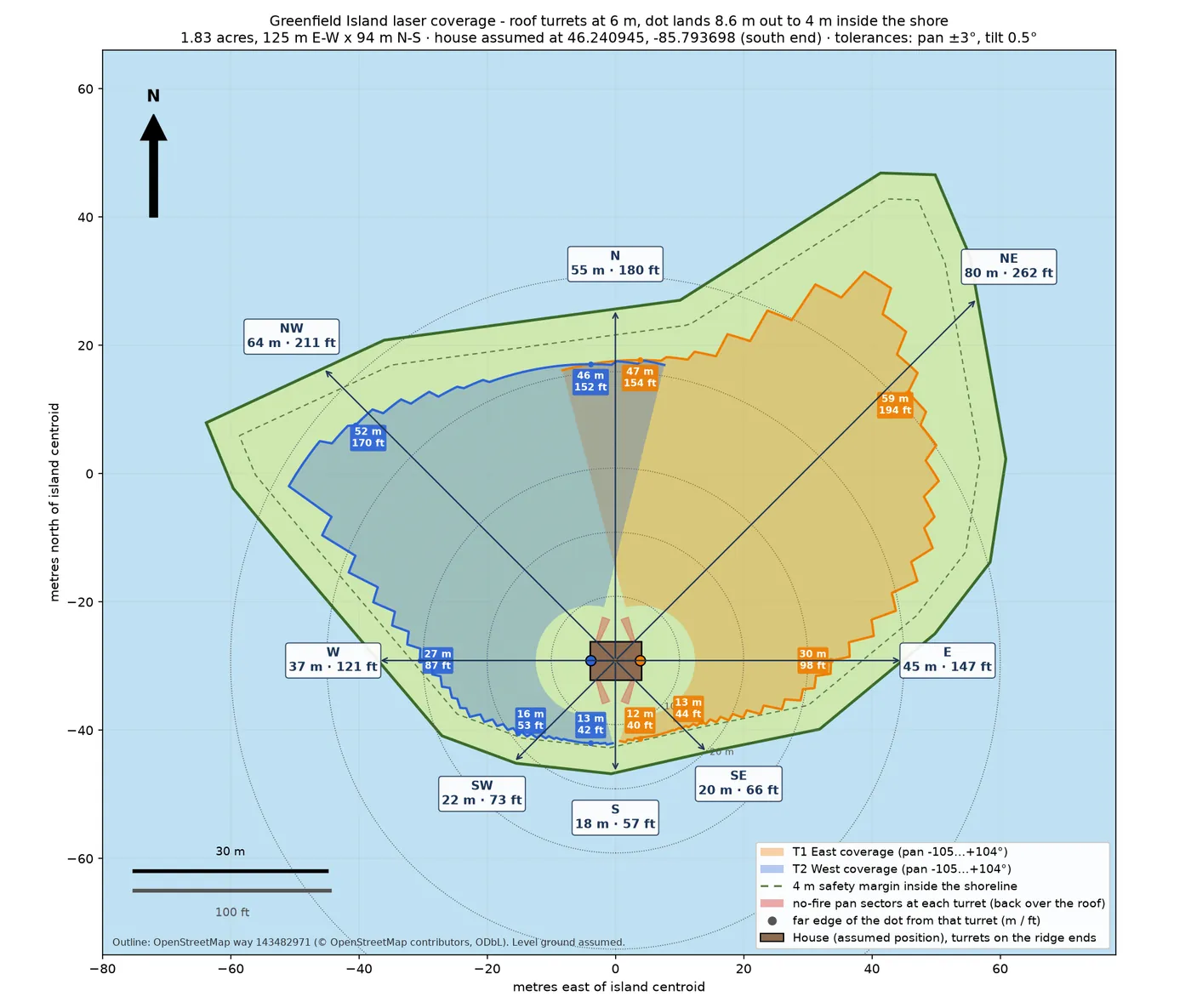
Gulls tend to treat a fast-moving dot of green light on the ground as a threat and move off. The turrets sweep it across the land where gulls like to sit, never at the birds and never at people.
The beam only ever points down at the ground below the horizon, in sweeps across the island's open land.
A light sensor and a schedule focus activity on dawn and dusk, when gulls come in to settle and the dot shows best.
Sweeps, pauses and paths are randomized, with rest periods in between, so the birds don't get used to it.
Off-grid on solar and LiFePO4 batteries, in industrial weatherproof housings, online over Starlink with a phone dashboard.
Lasers deserve respect. Every layer below works on its own, so one failure doesn't leave a beam running.
A camera watches the coverage area. The moment it sees a person, every laser on every unit goes off and stays off until nobody has been seen for 120 seconds. It can't be overridden from the dashboard.
If the camera or its watcher goes offline, or can't see, the lasers stay off. No picture means no laser.
Each turret's aim limits are mapped from the island's real shoreline, direction by direction, so the dot always lands on land with a margin inside the shore. Never on the water, where reflections are unpredictable.
A physical stop keeps each turret from tilting up to the horizon, whatever the software does.
No key, no laser power. The units can't fire without it.
The dashboard's E-STOP turns off every laser on every unit. The premium version adds a physical emergency-stop button on the hardware.
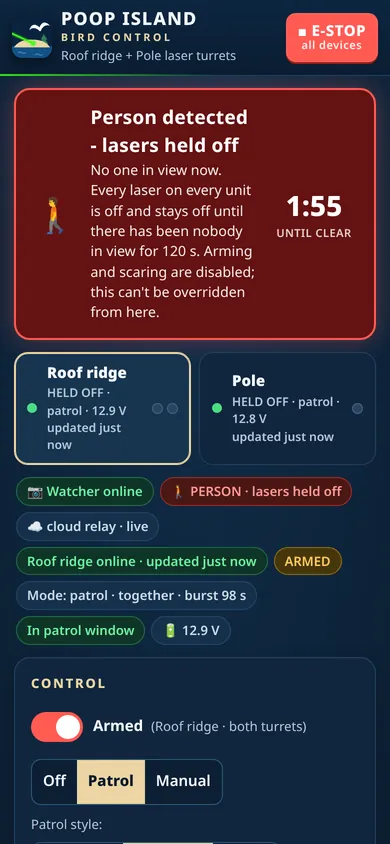
What the phone shows when the camera sees someone: every unit held off, with a countdown to clear.
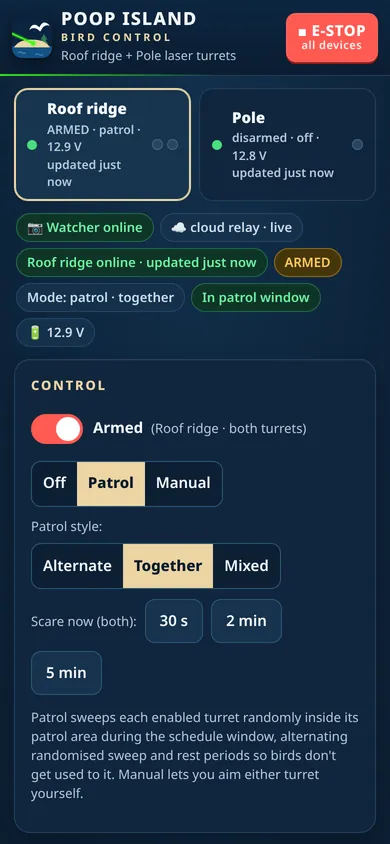
Arm, patrol and check on every unit from anywhere over the cloud relay. Same brand, same safety states: red means stop, amber means the camera can't vouch for the area, and laser green only ever means the laser.
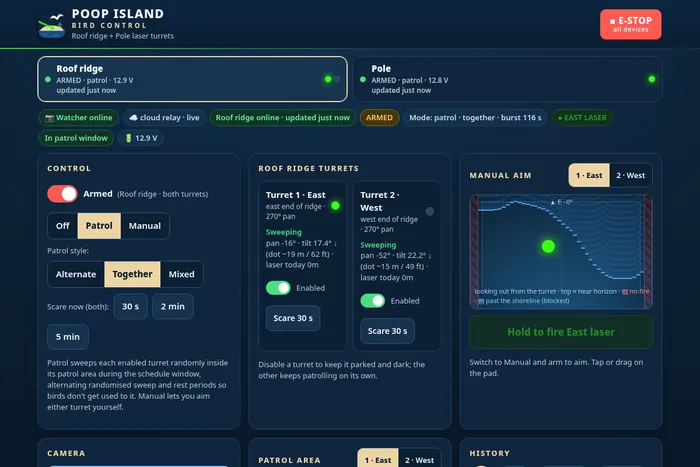
Everything is designed to live outdoors on an island: weatherproof, solar-powered and reachable over Starlink. These are renders of the prototype design.
Two turrets on the ends of the roof ridge, each a pan-tilt head under a clear dome. Between them they cover a full ring of ground around the house.
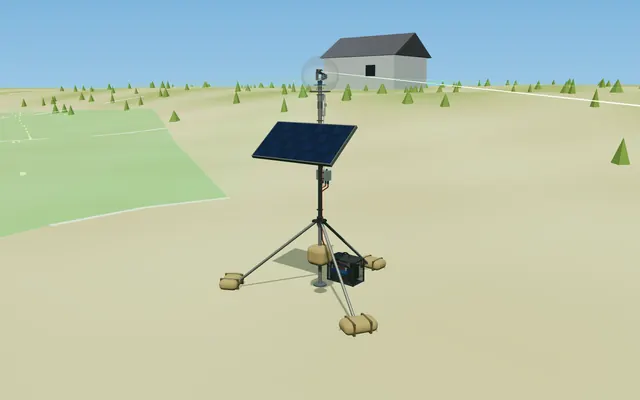
A standalone unit with its own solar panel and battery, on a ground screw or tripod base. It breaks down into sections to carry to wherever the gulls are.
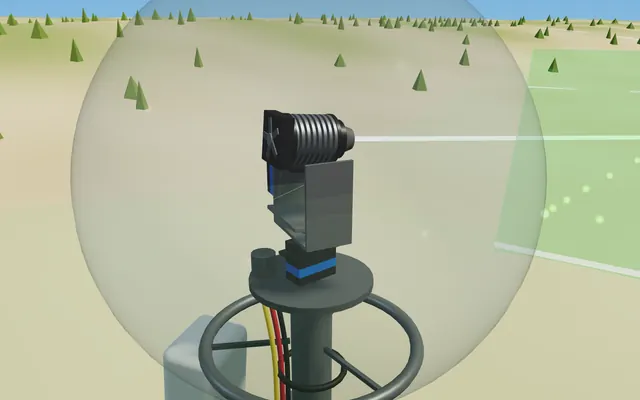
Industrial weatherproof housings, LiFePO4 batteries and solar charging, with the camera and the safety interlocks wired in from the start. The pole prototype's laser head is moving from the dome shown here to a sealed camera-style housing with a flat window and a sun visor, turning on a pan bearing.
Greenfield Island is about 1.8 acres in the Manistique Lakes, in Michigan's Upper Peninsula. It's owned by Todd Pierantoni, who bought it and hasn't been able to enjoy it since, because of the gulls.
Ring-billed and herring gulls made it theirs, and the island earned the nickname Poop Island. It's Flap Off's first install: the system was built to give the island back, and that's where it is being tested through 2026 and 2027.
We'll measure, not guess. Here's the plan:
Count the gulls on the island with the lasers off, to know what normal looks like.
Run the system and count every day with automated AI gull counts from the camera (planned).
Publish the before-and-after numbers here, whatever they show.
Results coming in 2027 as counts come in. No numbers are shown until real counts exist.
Not yet. Flap Off is an experimental prototype in field testing, not a product for sale. It isn't certified and the results aren't proven. Join the list below to hear how the test goes.
No. The beam is never aimed at birds. It sweeps the ground, and the gulls choose to leave. Gulls are protected, and the system is designed to haze them without harm.
A future commercial version would use Class 3B lasers only, with all of the safety layers above.
Nothing is for sale yet. We'll email when there's Flap Off news: the first counts from Poop Island, the results, and if a version ever becomes available.